Don't Blindly Trust AI
Hi everyone, this is Neo.
Recently, the BBC interviewed Google CEO Sundar Pichai, and the interview caused quite a stir on Twitter.
BBC News posted an official tweet with the caption: “Google CEO Pichai says, don’t blindly trust what AI tells you.”
Reading that, a lot of SEOs and independent site owners probably felt a jolt: Even Google itself is sounding the alarm on AI? Should those of us who haven’t gone all-in on AI be bailing out?
Hold on. As someone who’s spent years in the trenches running independent sites, I dug through the full interview — and it turns out things aren’t that simple.
BBC’s tweet was actually a bit of cherry-picking. What Pichai really meant isn’t doom and gloom at all — it’s a shot of adrenaline for us high-quality content creators.
Today, Neo is going to walk you through the interview and break down what Google’s view of the “AI and information ecosystem” really means for us — and what opportunities it leaves on the table.
1. Clickbait Misleading vs. Pichai’s Actual Point
Throughout the interview, the host kept trying to steer the conversation into the narrow alley of “AI is unreliable.”
The host pushed again and again:
- “Is AI reliable?”
- “Isn’t AI making information untrustworthy?”
- “Since Gemini (Google’s AI model) can make mistakes, shouldn’t Google be held responsible?”
Facing these traps, Pichai’s answers were masterfully handled. He didn’t deny that AI makes mistakes — he just raised the perspective.
He said: “The current AI technology is indeed prone to errors. That’s also why people still use Google Search.”
He used an analogy: if you want to do some creative writing, AI is a great tool; but if you’re looking for verifiable facts, you need “grounding.”
Neo’s take: Pichai’s blunt honesty actually reveals a core logic: AI isn’t a source of truth — it’s a tool that predicts the next word based on probability. What does that mean for independent site owners? It means users still need to “verify” information. AI can give an approximate answer, but “trust” still lives with search engines and authoritative websites.
2. “Trees” vs. “the Forest”: AI Actually Enriches the Information Ecosystem
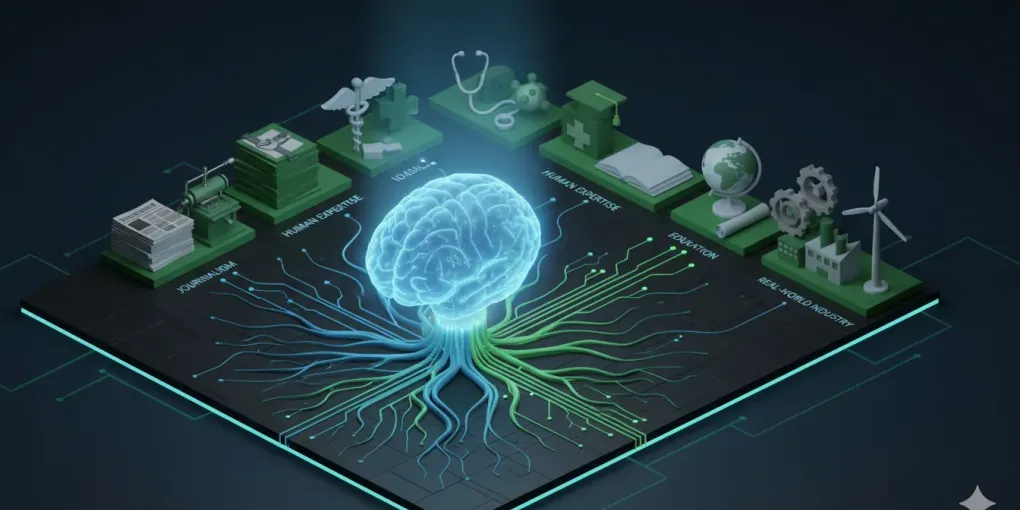
The best part of the conversation was watching the host fixate on the “tree” that is AI, while Pichai kept talking about the whole “forest” — the information ecosystem.
Pichai emphasized a concept: the Information Ecosystem.
He said: “If we only build AI as a single system in a vacuum, there would indeed be problems. But our information ecosystem has to be richer than just AI alone.”
Richer how? Pichai listed several key players:
- Journalism
- Doctors
- Teachers
- Experts
He believes AI is part of the ecosystem, but it can’t replace the wisdom and judgment of human experts.
Neo’s take: This point is huge! A top Google executive is explicitly saying: AI isn’t here to replace websites — it’s part of the ecosystem. Google’s AI (like AI Overviews) relies on grounding technology to anchor AI-generated answers to real-world information. Where does that real-world information come from? From your website, from my blog, from experts’ articles. Without us “human experts” supplying the data sources, Google’s AI would have nothing to draw from.
3. Why Is This a “Window of Opportunity” for Independent Sites?
Did you notice? The roles Pichai mentioned — “journalists, doctors, teachers” — map directly to the core SEO concept of E-E-A-T (Experience, Expertise, Authoritativeness, Trust).
He’s hinting: in the AI era, human expertise endorsement is worth more than ever.
The host asked: “Does Gemini always tell the truth?” Pichai answered: “It’s based on statistical prediction. That’s why we use Google Search as a tool to ground it.”
That means Google’s algorithmic logic is undergoing a subtle but profound shift:
- AI handles “synthesis” and “presentation”: It processes general, common-sense information.
- Search handles “verification” and “trust”: It links to high-authority, real human sources.
For B2B independent sites or niche B2C sellers, this is fantastic news. As long as your content has exclusivity and expertise, Google’s AI has to cite you — because without your data, its AI would “talk nonsense.”
4. 3 Practical Tips for Independent Site Owners and Operators
After listening to the interview, combined with my recent hands-on observations, here are three tips:
① Don’t Be an “AI Parrot”
If you’re just using ChatGPT to generate piles of “correct platitudes,” you’ve become part of the “error-prone, groundless AI” Pichai described. Google doesn’t need another AI to repeat what its own models already know. You need to produce “incremental information.” Like exclusive product reviews, customer case studies, and unique insights about your industry.
② Build Your “Digital Fingerprint”
Pichai emphasized concrete identities like “doctors” and “teachers.” On your website, you absolutely need a clear author bio. Tell Google: this article was written by a living, breathing engineer with 10 years of experience — not generated by an account that just signed up.
③ Embrace the “Grounding” Concept
In your articles, cite authoritative data and provide verifiable facts. And conversely, work to make your brand a “source of truth” that others cite. When AI needs to ground an industry statistic, I want it to anchor to your website.
Summary
Sundar Pichai’s interview, on the surface, admits AI’s shortcomings. Underneath, it’s an endorsement of the hybrid future of “AI + human experts.”
Don’t be scared off by the “Don’t blindly trust AI” headline. On the contrary, you should feel more confident: because AI can’t be blindly trusted, your expert brand is worth more.
Stay focused and keep producing high-value content that AI can’t write. That’s our biggest moat in this algorithmic upheaval.
References:
- BBC Interview with Sundar Pichai (November 2025)
- Search Engine Journal: Google CEO Sundar Pichai Says Information Ecosystem Is Richer Than AI