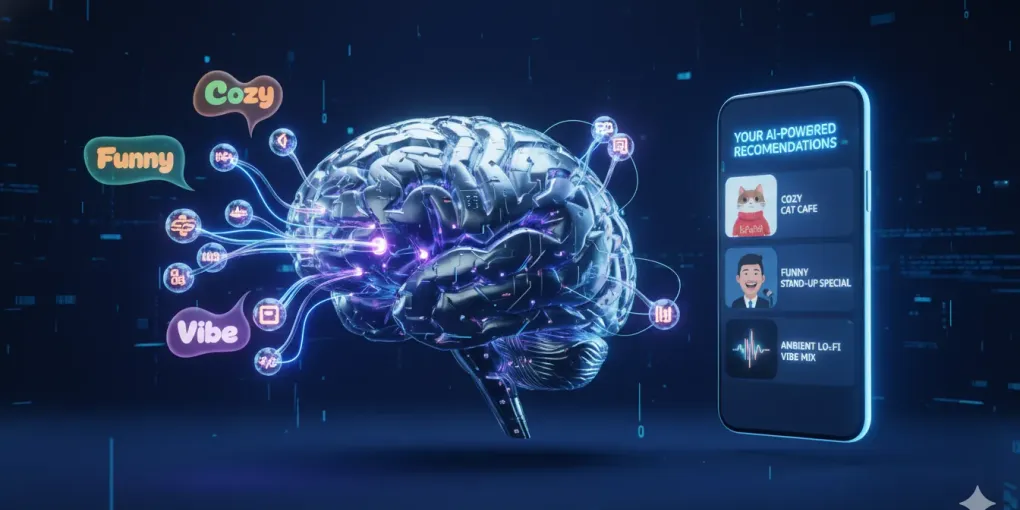
Google AI's New Breakthrough: How It Reads Between the Lines of What You Search
Hi everyone, this is Neo.
The longer you work in niche sites and cross-border e-commerce, the more you run into this pain point: my product is great and the specs are super detailed, but users just can’t find it — or the recommender system keeps pushing irrelevant stuff at users.
A lot of the time, users don’t just want a “red, cotton, crew-neck” t-shirt (those are hard specs). What they actually want might be something that “looks slimming,” “feels chill,” or “works for a Friday night date.”
Those qualities — “slimming,” “chill,” “date-worthy” — are what we call “vibes,” and in technical terms they’re known as “soft attributes.”
Recently, Google Research published a major study: they found a new way to make recommender systems understand not just the specs, but also the user’s unspoken intentions behind the search.
Today I’m going to break down this technology and what it means for our niche sites and content marketing.
1. Why Recommender Systems Never “Get You”
Most recommender systems today (think Amazon, YouTube, Google Discover) still work off “hard attributes.”
- Hard attributes: Objective facts — a movie’s director, a product’s color, price, material.
- Soft attributes: Subjective perceptions — “funny,” “healing,” “brain-bending,” “premium feel.”
Traditional algorithms handle hard attributes beautifully, but they completely fumble soft attributes. Why:
- No standard answer: What even is “premium feel”? A thousand people, a thousand Hamlets.
- Huge personal differences: A joke I find “hilarious” might make you cringe.
So when a user searches “funny gift,” the system can only recommend popular items tagged “funny” — it can’t actually understand what this particular user finds funny.
2. Google’s New Move: CAVs (Concept Activation Vectors)
To solve this, Google researchers came up with a new concept: Concept Activation Vectors (CAVs).
Don’t run from the fancy name — let me give you an analogy.
Imagine the recommender system is a STEM student who only speaks math, while the user is a liberal-arts student who talks in nothing but “vibes” and “atmosphere.” The two can’t communicate at all.
CAVs are like a “translator.”
- Translating user language: When a user says “I want a brain-bending movie,” CAVs translate “brain-bending” into a set of math coordinates (a vector) the STEM student (recommender system) can understand.
- Personalized tuning: The killer part — this translator is custom-made. It learns your definition of “brain-bending.”
- For user A, “brain-bending” might mean the intricate logic of Inception.
- For user B, “brain-bending” might mean the twisty turns of a mystery-thriller.
The system doesn’t need to relearn everything about all movies — it just nudges its direction through this “translator” and can precisely recommend movies matching your definition of “brain-bending.”
Neo’s take: The genius of this tech is that it doesn’t require tearing down existing recommender systems and starting over — it’s like installing a “semantic understanding plugin.” That means Google can apply it to YouTube, Google Search, even Google Shopping at very low cost.
3. How Does This Technology Actually Work?
In simple terms, Google’s approach is:
- Use existing models: Start with the existing collaborative filtering model (the one that recommends based on “people who bought A also bought B”).
- Map semantics: Through CAVs, map users’ “soft attributes” (like “cozy”) into the model’s mathematical space.
- Separate subjective from objective: The system automatically identifies which words are objective (“red”) and which are subjective (“good-looking”), then personalizes the subjective ones.
The research shows this approach dramatically outperforms traditional methods at understanding users’ subjective intent.
4. What Does This Mean for Us in Cross-Border E-commerce?
Even though this is a technical paper, we operators and owners need to keep our noses sharp.
1. Content Marketing Should Focus on “Vibe” and “Scenario” Words
We used to write listings by piling on keywords: Size, Color, Material. Going forward, we need to pay more attention to “soft attribute” keywords.
- Don’t just write “high-thread-count sheets” — describe “cloud-like comfort.”
- Don’t just write “noise-canceling headphones” — describe “instant focus mode.”
As Google’s algorithms evolve, it will increasingly favor products that accurately convey “soft attributes” and recommend them to users with matching needs.
2. Planting Words in Reviews Matters
User reviews are full of “soft attribute” descriptions.
- “This dress makes me feel so confident.”
- “The vibe is very cozy.” These words will be captured by algorithms and become the key bridge connecting you to potential customers. Guiding users to leave specific usage feelings in reviews is far more valuable than a plain “Good product.”
3. The Future of Search Is “Intent Search”
Google Discover and future AI search will no longer be simple keyword matching — it’ll be intent matching. When a user looks for “a gift for a picky girlfriend,” your product is far more likely to surface if it’s tagged with soft attributes like “Unique,” “Thoughtful,” “High-end” (through copy or reviews).
5. Summary
This research proves once again that AI is evolving from “logical computation” to “semantic understanding.”
As niche site operators, we can’t just be cold spec-sheet porters — we need to become content creators who understand user emotions and convey the warmth of products.
Key Takeaways:
- Soft Attributes: Users’ subjective feelings (funny, slimming, etc.) are the next gold mine for recommender systems.
- CAVs Technology: Google uses it to convert subjective feelings into mathematical language for personalized recommendations.
- Strategy: Add scenario-based, emotion-driven descriptions (Vibe, Mood, Feeling) to your listings and content, catering to AI’s semantic intent understanding.
References: