
Rank on Page 1 in 24 Hours? The SEO 'Cheat Code' No One Talks About: KGR (Keyword Golden Ratio)
Hi everyone, this is Neo.
What’s the most painful part of running a niche site — especially a brand-new one?
It’s the loneliness.
You pour your heart into a dozen articles, check Google Analytics every single day, and your traffic is a big fat “0.” It feels like giving a speech to an empty room. Plenty of people in cross-border B2B or B2C give up right in this “sandbox phase,” convinced SEO is too hard and the competition too strong.
And honestly, if you sit down today to write for “best running shoes” or “China furniture manufacturer,” you’re probably wasting your time. Those keywords are locked down by the industry giants.
But what if I told you there’s a way to get a brand-new article onto Google’s page 1 — even the top few spots — within 24–48 hours of publishing? Would you believe me?
It’s not black-hat SEO. No backlinks required. It’s pure content strategy.
It’s called KGR (Keyword Golden Ratio) — in Chinese circles we call it the “keyword golden ratio,” and niche site builders treat it as the go-to “starter site secret weapon.”
Today, let’s tear this strategy apart in depth and see whether it still holds up in 2025.
What Is KGR (Keyword Golden Ratio)?
[Image suggestion]: KGR filtering funnel model
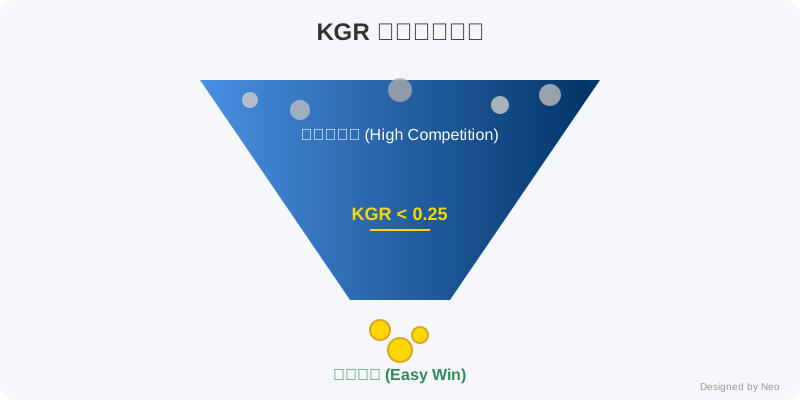
KGR was coined by Doug Cunnington, a well-known name in the niche site world.
In plain terms, KGR is a data-driven method for finding keywords where supply and demand are wildly out of balance.
- Demand: People search for it, but volume is low (the big players don’t bother).
- Supply: Almost no page is optimized specifically for that phrase (competition is minimal).
When supply is far below demand, Google has no choice but to rank your article up top. That’s the core logic of KGR.
The Core KGR Formula (Bookmark This)
[Image suggestion]: KGR core formula visualization
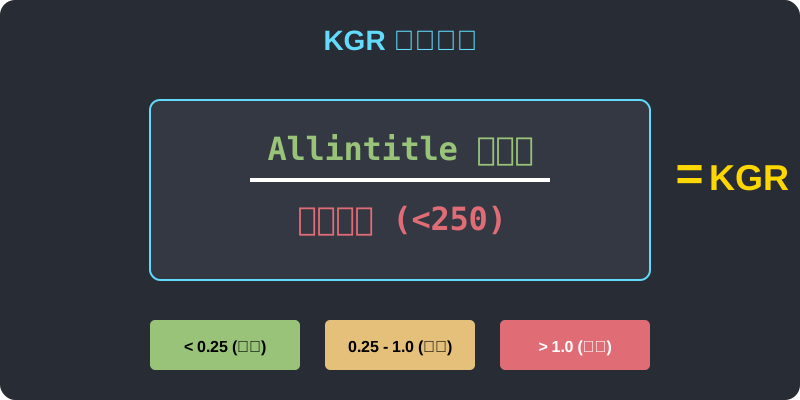
The KGR formula is dead simple, but the impact is huge:
KGR = allintitle results / monthly search volume
There are two hard thresholds here, and you must respect both:
- Monthly Search Volume: Must be under 250.
- Allintitle Results: The number of results returned by the Google search operator.
The Gold Standard:
- KGR < 0.25: Jackpot. If your content quality is solid, there’s a very high chance your post lands in Google’s top 50 — usually page 1 — within days, sometimes hours.
- 0.25 < KGR < 1.00: Decent. You have a shot at ranking, but it may take a bit longer or need a few backlinks for support.
- KGR > 1.00: Skip it. Too competitive for a new site to fight head-on.
Hands-On: How to Mine KGR Keywords (Step by Step)
[Image suggestion]: KGR 4-step workflow

Talking is cheap — let’s actually do it. Say we’re in “Pet Supplies.” How do we find KGR keywords?
Step 1: Brainstorm and Expand Long Tails
Don’t search “dog food” (that’s asking for trouble). Use Google Autosuggest or tools like Ahrefs, Semrush, Keyword.com, Ubersuggest, etc.
Try typing: best dog food for...
Google might suggest:
- best dog food for shih tzu with allergies
- best dog food for golden retriever puppy diarrhea
Step 2: Verify Search Volume
Drop those phrases into a keyword tool.
Say we find one: “best collar for aggressive german shepherd” with a monthly volume of 150.
Meets the “volume < 250” rule. Pass!
Step 3: Verify Competition (Allintitle)
This is the most critical step — and the one most people skip.
Type this into the Google search box:
allintitle:best collar for aggressive german shepherd
Note: Don’t add a space after allintitle:.
This operator tells Google: “Only show me pages whose titles fully contain this exact set of keywords.”
Say Google returns 15 results.
Step 4: Calculate KGR
Time for some arithmetic:
- Allintitle results = 15
- Search volume = 150
- KGR = 15 / 150 = 0.1
0.1 is under 0.25! Congrats — you just found a golden keyword. Write a high-quality article on that topic and you’ll almost certainly land on page 1.
Neo’s Take: Can KGR Still Be Played This Way in 2025?
[Image suggestion]: Neo’s KGR strategy: many drops make an ocean

KGR has been around for a few years now — is it still effective? Based on my latest hands-on experience, here are a few deeper insights:
1. Why Must It Be Under 250 Searches?
A lot of business owners look down on that traffic. “Only 250 searches a month? That’s nothing!” That’s exactly the point of KGR. Because the volume is low, big sites (Amazon, Wayfair, industry giants) can’t be bothered writing for that keyword. That leaves the door open for new sites with low authority. Many drops make an ocean. One article brings 50 highly targeted visits; write 100 KGR articles and that’s 5,000 targeted visits. For B2B, that could mean dozens of quality inquiries.
2. The B2B Twist
If you’re in B2B, KGR is practically a superpower.
B2B keywords usually have very low search volume.
Take custom heavy duty industrial caster wheels manufacturer — that might only get 50 searches a month.
By KGR logic, as long as the allintitle results are under 12 (50 * 0.25), it’s a must-do keyword.
Neo’s advice: In B2B, don’t sneeze at low volume — one precise buyer’s search is worth its weight in gold.
3. The “Zero Volume” Trap — and the Opportunity
Sometimes a keyword tool shows 0 monthly searches for a long-tail phrase. But! Google’s autocomplete dropdown still suggests that phrase. Trust Google, not the tools. If Google suggests it, people are searching for it. In that case the KGR denominator approaches zero — you can’t compute it, but it usually signals a fantastic opportunity. These are the blue-ocean-est of blue oceans.
4. The Pitfall: Don’t Do KGR for KGR’s Sake
KGR only finds you the opportunity — it doesn’t give you a license to publish garbage. If your article is all fluff, even if it ranks, Google’s algorithms (RankBrain, BERT) will notice the sky-high bounce rate and kick you right back down. Content is still king. Actually solve the searcher’s pain point behind that long-tail query.
Pros and Cons of the KGR Strategy
[Image suggestion]: KGR pros and cons comparison
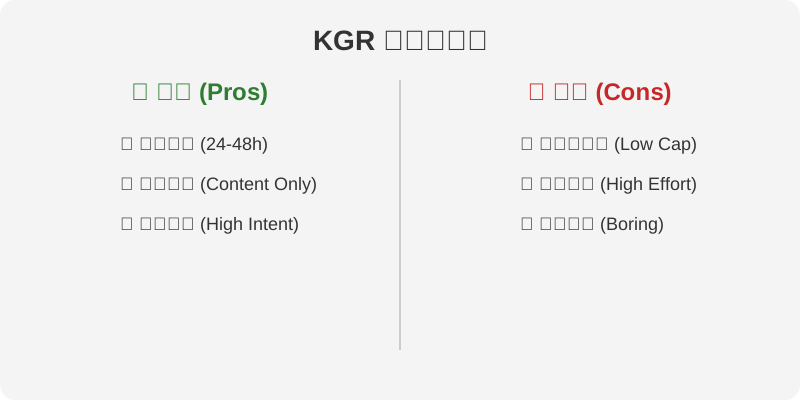
Before rolling this out at scale, let’s weigh it honestly:
✅ Pros
- Fast results: Even new sites can rank within days, which is a massive confidence boost.
- No backlinks: No begging around for guest posts — content alone can win.
- Targeted traffic: People searching long-tail keywords usually have very strong purchase intent.
❌ Cons
- Low ceiling: A single article’s traffic cap is low — hard to blow up off one post.
- Volume of work: You need to “stack” a lot of articles to see meaningful traffic growth.
- Tedious: Manually checking allintitle gets old fast (though some tools can help now).
Summary
SEO isn’t a game only the giants can win.
KGR is like guerrilla warfare for the little guy. We don’t fight the big head terms head-on; instead we capture one overlooked “small hill” after another until we’ve surrounded the city from the countryside.
Neo’s action plan:
- Stop staring at the big keywords.
- This week, mine 5–10 KGR keywords.
- Write content that’s better than what’s ranking right now.
- Watch for 2 weeks — you’ll come back and thank me.
SEO is a marathon, but KGR lets you sprint a little at the starting line.
Keep going, fellow global builders!
References: