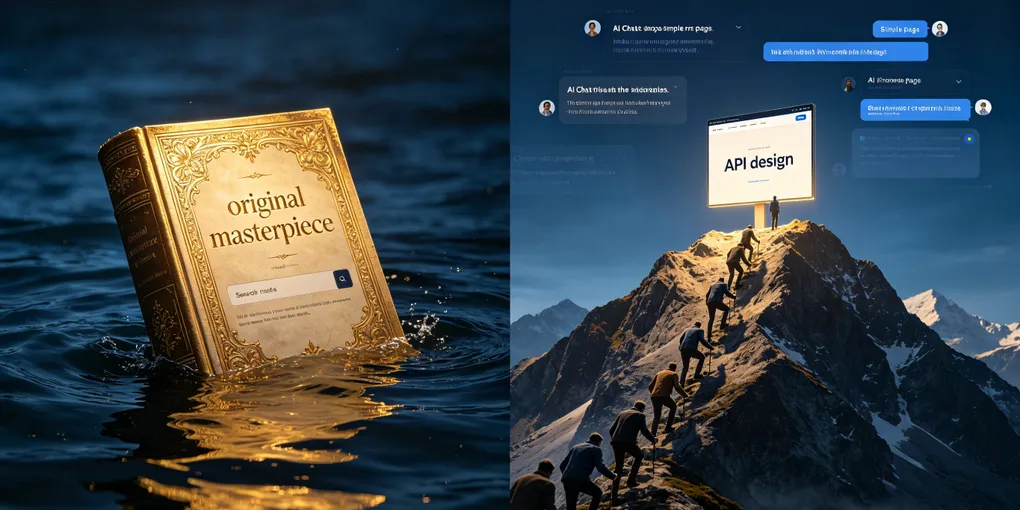
Your Masterpiece Is Sinking on Page 4
Hi everyone, this is Neo.
Today we’re talking about something that makes content creators want to quit:
You spent two weeks researching and carefully polishing an original long-form piece — then it goes live and sinks like a stone to page 4. Meanwhile, the 500-word listicle next door is ranking #1.
And it’s not just you. The author’s team recently ran a fascinating study comparing “high-quality original content” against “repurposed/patchwork content” across Google rankings and AI citations. The results may surprise you.
Here’s the conclusion up front: AI does favor originality — but originality isn’t a silver bullet. In many cases, “getting there first” matters more than “being the best.”
1. High-quality content = high rankings? Don’t be naive
SEO and content marketing have a long-standing article of faith: high-quality, original, in-depth content wins.
Every major Google update preaches the same message — stop writing keyword-stuffed, hollow listicles. LLM citation research reinforces it: if you want AI to cite you, your content has to be among the best on the topic anywhere online.
But there’s a massive gap between theory and reality.
In reality:
- Your carefully crafted piece is fighting for its life on page 4
- The “fluff” you look down on owns position one
- The 10-page whitepaper you paid a fortune for performs about the same as the 5-page version
- While you were chasing “perfection,” competitors filled the topic space
Where’s the problem?
The author hits the nail on the head: “high-quality content” is a fuzzy concept. Ask ten CMOs, SEOs, or content marketers to define it and you’ll get fifteen different answers.
- Does “high quality” mean thought leadership? Or can skilled writing + polished formatting package an ordinary opinion as high quality?
- Does “depth” mean lots of words and heavy research? Or genuinely deep understanding of the topic that explores more nuanced ideas?
- How original is “original”? Does citing other people’s research lower your originality score?
Neo’s take: Running content marketing for independent sites, I’ve watched too many teams pour 80% of their budget into “making the best content,” only to launch and find that a competitor who published two weeks earlier has already captured the traffic. “High quality” is a necessary but not sufficient condition — without it you definitely lose, but with it you’re still not guaranteed to win.
2. What the research found: originality helps, but the correlation is weak
The author’s team ran a qualitative study comparing original content against repurposed content across Google search and AI citations (Gemini, ChatGPT, Perplexity).
The study focused on mid-funnel informational queries in B2B SaaS and professional services — think “marketing automation tools,” “email deliverability tools.”
They scored every ranking URL on five dimensions (0–3 points each):
- Primary contribution
- Structural novelty
- Interpretive depth
- Source dependence (lower is better)
- Contextual insight
Out of 15 points total, grouped as:
- 12–15 points: Group A (original)
- 7–11 points: excluded
- 0–6 points: Group B (repurposed/patchwork)
Initial results: Group A (original) did rank more stably in Google and got cited more often in AI answers.
But wait — when the data analyst dug deeper (using statistical methods with “a lot of Greek letters”), the finding was: the correlation exists, but it’s weak.
Strong performance in one part of the dataset doesn’t reliably predict performance in another. The relationship isn’t consistent enough to confidently say “highly original content performs better every time.”
Neo’s take: This research actually feels true to life. We’ve seen the same pattern with independent-site content: a genuinely original deep piece does get cited by AI more easily. But its Google rankings depend far more on backlinks, domain authority, and user behavior signals than on “content quality” alone. Originality is a bonus factor, not a deciding factor.
3. When does originality matter? When doesn’t it?
The research didn’t prove originality is “always” better, but it did reveal a meaningful pattern:
Originality matters more for queries that need interpretation or judgment
For example:
- “benefits of marketing automation”
- “email marketing best practices”
These questions have no single right answer — they need opinions, judgment, and experience. Original insight genuinely helps you stand out here.
Originality barely matters for simple factual queries
For example:
- “what is marketing automation”
These questions have factual answers. Here, accuracy matters more than originality. You don’t need to invent a new definition; you just need to explain the existing one clearly.
Summary: Originality helps in certain contexts, for certain query types. But it’s not a lever that “guarantees results.”
Neo’s take: This has direct implications for independent-site content strategy. Your content matrix needs both “factual content” (answering what/who/when questions — prioritize accuracy and completeness) and “opinion content” (answering why/how/best questions — prioritize originality and depth). The former doesn’t require you to invent new theory; the latter requires insights competitors don’t have. Mix both — don’t chase “thought leadership” with every single piece.
4. A real case: how mediocre content beat the industry giants
The author shared a case that stuck with me.
In the 2010s, the API industry exploded. API docs, technical specs, and implementation guides flooded out. The author’s client was a 10-person API startup facing a market full of giants — competitors with massive content budgets, mature domain authority, and comprehensive resource libraries.
The conventional play: fight the giants’ “volume” with “high-quality original content.” Build the deepest API resource anyone’s ever seen; establish authority with original research.
But that wasn’t realistic — the client didn’t have the budget or time to go all-in on every API subtopic.
So they flipped the strategy: instead of fighting the giants head-on for today’s hottest keywords, go after the keywords that might become hot tomorrow.
They did something simple: they ran a survey asking target users what search terms they’d use in specific scenarios. Besides “API,” one word kept coming up: “design.”
“API design” had almost zero search volume at the time — no standard keyword research would ever surface it. But the survey made it clear: as the industry matured, user search behavior would evolve too.
More importantly: no competitor was targeting that term.
So they made a decision: don’t chase perfection, chase speed. Within days they put up a simple ~1,500-word landing page focused on “API design.” The content was unremarkable — not comprehensive, hardly award-winning.
12 months later, the search volume arrived as predicted. That modest page kept outperforming every giant that eventually piled in — even as they threw landing pages, content hubs, and more resources at it.
2 years later, the “API design” keyword was worth roughly £200 per click. And the startup never had to pay for those clicks — they’d won the space before anyone realized it was worth fighting for.
Neo’s take: This case perfectly illustrates a core strategy for independent-site sellers — instead of being the best in a red ocean, be the first in a blue one. A 10-person startup can’t beat Postman or Stripe on “API documentation.” But they built a first-mover advantage on “API design.” Same logic for independent sites: don’t bang your head against “best running shoes” — find long-tail terms that aren’t well covered yet but whose search intent is trending up.
5. Perfection is the enemy of good
The author distills an important lesson from this case:
“Striving to achieve the best possible iteration of your content, endlessly refining and polishing and second-guessing every detail, can get in the way of just getting it out there. Sometimes, good enough really is good enough.”
Chasing perfection — endlessly refining, polishing, second-guessing every detail — can actually stop you from shipping.
I’m not saying we should abandon the pursuit of excellence. As the research showed, well-researched, original content does give you an edge in some situations. And rankings and clicks are only the first step — once users click through, your content still has to be good enough to move them, convince them, and drive them to act.
But success depends at least as much on timing as on quality or originality.
The “API design” page didn’t win because it was mediocre. It won because they got there first. Quality matters — just not the kind of quality the traditional content playbook defines.
Neo’s take: For independent-site content, “speed to publish” and “breadth of coverage” usually matter more than “single-piece perfection.” Too many teams spend two months on a “definitive guide,” then launch to find competitors already published five mid-tier pieces covering every related keyword. My advice: adopt a “minimum viable content” strategy — cover a topic fast, earn rankings and feedback, then iterate. Content can be revised. Lost timing can’t be recovered.
6. A new lesson for the AI era
This finding matters even more in the age of AI search.
What can LLMs do? Organize ideas, summarize information. What they can’t do — at least not yet — is produce original thought, first-hand experience, or fresh perspectives.
Which means: in AI search, being an “original source” carries real weight.
When an AI is asked a question that requires judgment and opinion, it tends to cite sources with original insight rather than content that merely aggregates other people’s views.
Of course, the research also shows this isn’t guaranteed. But the trend is clear.
So the action is simple:
Ask yourself — what can your content say that hasn’t been said yet? Then say it before anyone else.
Neo’s take: In the AI search era, the value of “originality” may get amplified further. AI needs sources to back up its answers, and sources offering unique perspectives, unique data, and unique experience become more valuable citation targets. But as the research reminds us, originality isn’t a cure-all — you still need the right timing, the right framing, and the right audience.
Summary
Key takeaways from today:
- “High-quality content” has no standard definition — and it’s not a ranking silver bullet
- Originality does help — but the correlation with Google rankings and AI citations is weak
- Originality matters more for “judgment” queries — and barely matters for simple factual ones
- Timing matters at least as much as quality: the API design case proves that mediocre-but-first content can beat latecomers’ “perfect” content
- Perfection is the enemy of publishing — sometimes good enough really is good enough
- In the AI era, original sources have value — LLMs can’t generate original thought, so they need to cite you
- The core action: find the angle nobody has covered, and claim it first
One last line: Don’t try to be the best at every topic. Find the opportunities nobody has fully covered, be a first mover, and optimize as you go.
I hope this gives you something to think about. If you have hands-on experience or a different view on content strategy, feel free to discuss in the comments.