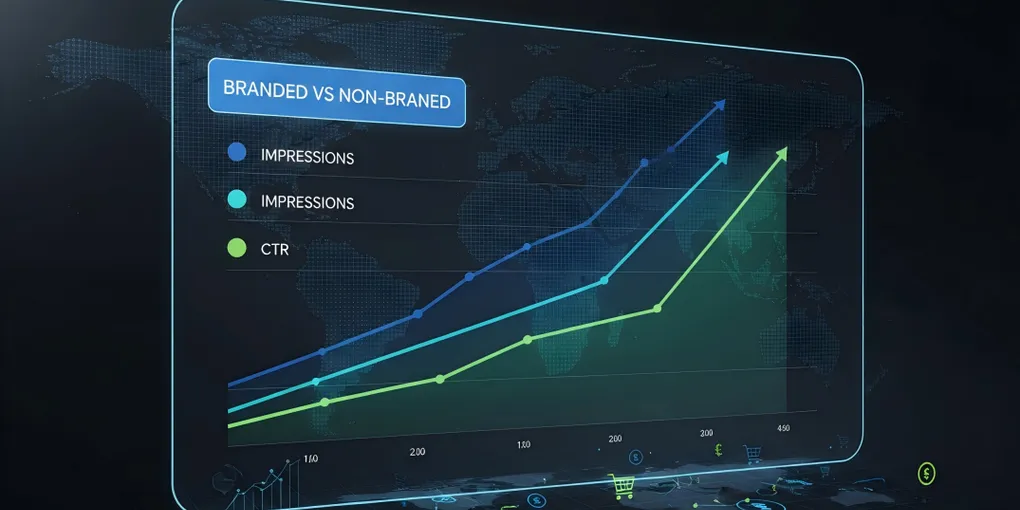
Search Console's Branded Queries Filter, Explained: How Independent Sites Can Track Brand and SEO Separately in the AI Era
Hi everyone, this is Neo.
Google has officially rolled out the Branded Queries filter in Search Console (SC) to a wider set of eligible sites. A lot of independent site owners and operators have been asking me: what can this feature actually do? What are the data gotchas? And in today’s AI-saturated landscape, what’s the real strategic value for Chinese cross-border businesses?
Drawing on Google’s official docs, John Mueller’s latest answers, and the industry trends we’re seeing in 2026 (especially the rise of AI Overviews and Copilot), here’s a practical guide that’s plain-spoken, in-depth, and actually actionable.
1. What Is the Branded Queries Filter and How Does It Work?
In plain terms, branded queries are searches that include your brand name, its common variants, misspellings, or product/service names strongly associated with your brand.
In SC’s Performance report, this new filter lets you segment queries by “branded” or “non-branded” with one click, so you can view impressions, clicks, CTR, and average position for each bucket separately.
A few hard limits baked into the official mechanism:
- Not available for every property: the filter currently doesn’t support subproperties (e.g.,
https://example.com/blog/). - Invisible on small sites: if your site’s total impressions are too low, or branded search volume is tiny, the filter may not show up at all.
Neo’s take: In the past, most people lumped branded and generic keywords together, creating the illusion that they rise and fall as one. Splitting branded queries out lets you see the two independent lifelines of your business growth:
- The brand-equity line: direct, name-your-brand purchases driven by awareness, word of mouth, PR, and marketing.
- The SEO competitiveness line: your ability to win traffic on non-branded (generic demand) keywords through content quality, backlinks, and technical SEO. These two lines have completely different health signals, owners, and budget strategies.
2. The Big Question: Can You Add Branded Terms or Misspellings Manually?
During testing, a lot of operators have found that variants they consider part of their brand aren’t recognized by SC. So the question everyone asks: can I add these terms to the filter manually?
The answer: not right now.
- Fully automatic recognition: John Mueller has confirmed there’s no way for site owners to define or submit brand variants. Brand detection is done entirely by Google’s algorithms.
- About misspellings: the official docs say misspellings are auto-detected (e.g., “Gogle” for Google). But if you find some misspellings aren’t picked up, it’s usually because search volume is too low — or Google’s autocorrect already kicked in on the search side, so those misspelled queries never generated any impression data.
Neo’s take: Don’t obsess over getting SC to recognize every branded term perfectly. It’s far more reliable to maintain your own custom brand-term dictionary in your BI or reporting stack.
Here’s the right workflow: use SC’s filter for coarse-grained segmentation, export the data, then re-tag it in your own Excel or BI dashboards using an internally maintained brand dictionary (English aliases, non-English variants, product-line codes) with regex matching. Combining both gives you the most reliable picture.
3. When Does the Data Start? Can You Look Back at History?
Practitioners (including real-world reports on LinkedIn) have noticed that this branded/non-branded split doesn’t apply retroactively to all of your site’s history. On many sites, data only starts from a recent date — February 21 in some cases.
Also, as mentioned earlier: if a small site gradually grows, the filter’s data may only appear at some future point, once branded search volume crosses the threshold.
Neo’s take: Since historical data is incomplete, don’t use today’s branded/non-branded ratio to reconstruct trends from six months ago — the error margin is huge.
The sensible move: treat the first day data becomes available as your baseline, and from now on track week-over-week and month-over-month changes for both buckets.
4. The Strategic View: Why You Must Separate Branded from Non-Branded
Based on Search Engine Journal’s write-up and our own hands-on experience, splitting the two is the watershed moment in sophisticated independent site operations:
- Sharper SEO diagnostics: swings in non-branded traffic directly reflect your site’s search competitiveness. If traffic drops, removing the brand factor lets you pinpoint whether it’s technical SEO (indexing issues, say) or declining content quality — rather than wrongly blaming last month’s paused Facebook brand ads.
- A barometer of brand health: growth in branded queries is an external signal that users trust you more. When people search “your brand + product term,” they’ve already skipped the comparison-shopping stage and are arriving with serious purchase intent.
- Avoid “average masking”: blend the two together, and the high conversion and CTR of branded queries will hide a weak non-branded SEO performance — and vice versa. That’s how founders make fatal budgeting decisions.
- More scientific growth forecasting: modeling them separately gives you two clean trend lines, so you can accurately measure the long-tail spillover that pure marketing plays (trade shows, influencer reviews, podcasts) create on the search side.
- An early-warning system for competition: if non-branded traffic stays stable while branded search volume keeps sliding, that’s usually a dangerous early signal — competitors are winning mindshare, or your market presence is being diluted.
5. Advanced Playbook for Chinese Cross-Border Sites in the AI Era (2026)
Now that AI answer engines like AI Overviews and Copilot dominate the search experience, watching traditional rankings alone isn’t enough. Combined with the branded queries filter, we should build a “dual-engine” strategy:
1. Build a Fine-Grained Data Dashboard
- Export on a schedule: filter by branded/non-branded in SC and export the last 90 days of impressions, clicks, CTR, and average position.
- Track the core metrics:
- Brand-equity index:
Branded Clicks / Total Clicks. The higher this ratio, the deeper your moat. - Non-branded competitiveness: watch your Top 10 ranking coverage and CTR trends on non-branded terms — they determine your customer acquisition cost.
- Brand-equity index:
- Cross-channel verification: cross-check SC data against GA4’s Direct traffic and Bing Webmaster Tools’ AI Performance report (which tracks citations in AI answers) to avoid attribution bias from any single platform.
2. Embrace AEO (Answer Engine Optimization) to Boost AI Visibility
- Solid technical foundation: don’t blindly go with pure client-side JS rendering — make sure you have SSR (server-side rendering) or prerendering in place. Googlebot can render JS, but many newer AI crawlers (OpenAI, Perplexity) still struggle with it. And don’t let Cloudflare-style shields over-block legitimate AI crawlers.
- Deploy a verified Source Pack (VSP) and llms.txt:
- Put
llms.txtin your site root as a discovery layer for AI agents. - Build a machine-readable “official facts pack” (VSP) with structured product specs, policies, and unique data. When AI crawlers find clean official data, the odds of your brand being cited in answers jump dramatically.
- Put
- The Golden Knowledge principle: your content needs to be a blend of unique insight and industry consensus — that combination is what makes LLMs most likely to linkify and cite it as an authoritative source.
3. Put Your Brand in “Scenarios,” Not Just Links
- Traditional SEO loves mass link building, but in the AI era you need repeated brand exposure in real problem-solving contexts — industry media, quality podcasts, B2B whitepapers, honest influencer reviews.
- Rising branded search volume usually reflects real marketing effectiveness better than link counts ever will.
6. Common Mistakes and How to Avoid Them
- Mixing up KPIs: never reward your SEO team for a rising branded-share — that’s usually the PR and brand marketing team’s work. The true test of an SEO team is how much new customer acquisition comes from non-branded terms.
- Getting spooked by the “Google Zero” panic narrative: don’t abandon SEO because of extreme outlier cases. Global data shows Google is still the biggest traffic source by far. As long as you keep publishing high-quality, non-clickbait content, traffic won’t go to zero — it shifts toward high-intent branded queries and AI-visible terms.
- Watching rankings while ignoring AI citations: ranking #1 no longer means winning the most traffic. If your content isn’t cited in AI Overviews, your real visibility is being badly underestimated.
Neo’s take: As an independent site owner or business lead, you must align on a single definition of success internally: non-branded terms measure search acquisition, branded terms measure brand equity, and AI citations measure visibility and trust. Agree on this data framework and cross-team friction drops by 80%.
7. Summary
- Core value: the real point of SC’s branded queries filter is separating “brand equity” from “SEO competitiveness” so budget allocation and problem diagnosis have solid evidence behind them.
- Tooling: stop wishing SC let you define custom brand terms — move that job into your own BI reports and handle it with precision there.
- The breakthrough in the AI era: cross-border independent sites can’t keep staring at the old “ten blue links.” You have to invest on the technical side (SSR, llms.txt, VSP) and the content side (Golden Knowledge) so your brand is “machine-readable and user-trusted.”
- Play the long game: set up a data dashboard keyed to your data-availability date as soon as you can, and cultivate both brand and SEO. That’s how you’ll drive acquisition costs down and margins up in overseas markets.