Stop Blindly Trusting GSC! Is 75% of Your Search Console Data Shrunk?
Hi everyone, this is Neo.
For DTC operators, Google Search Console (GSC) is practically the “bible” we read every single day. Traffic down? Check GSC. Rankings changed? Check GSC.
But what if I told you that the “bible” you stare at every day is missing pages and passages — that maybe only 25% of it is real? How would that make you feel?
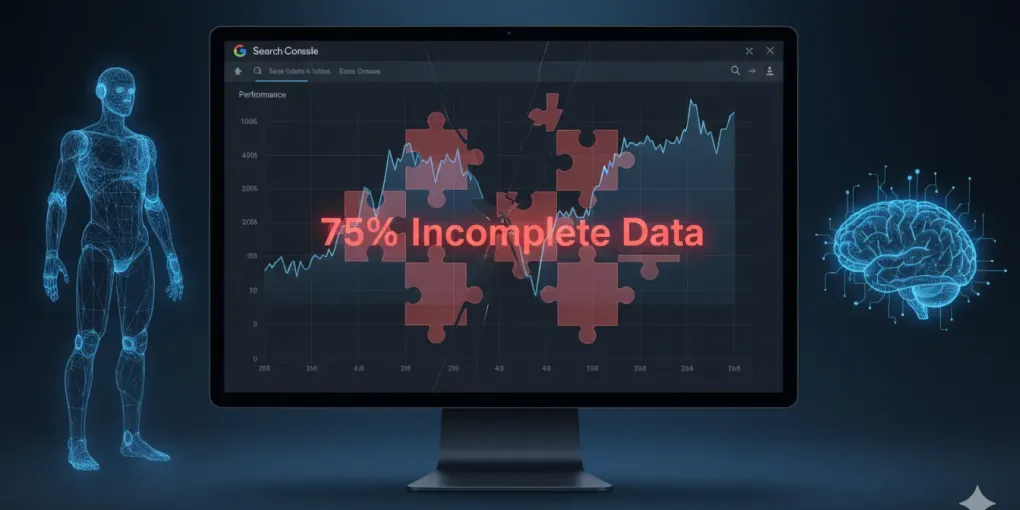
A recent deep-dive study might send a chill down your spine: up to 75% of GSC data is incomplete.
That means many of our SEO decisions, based on GSC, may have been built on “fragmented” data from day one.
Today, Neo is going to peel back the curtain on what’s really going on behind GSC’s numbers — and how we should respond.
1. GSC Was Once the Truth. Now It’s a “Rashomon”
There was a time when GSC was our most authoritative window into Google search results.
But over time, tighter privacy policies, the flood of crawler bots, and the aggressive arrival of AI Overviews (AIO) have seriously diluted GSC’s data reliability.
Especially over the past year (2025 into early 2026), three big events changed the game entirely:
- SearchGuard (January 2025): Google tried to block bots with complex captchas and signals — but it’s a cat-and-mouse game, and bots always find a new hole.
- AI Overviews explosion (March 2025): AI Overviews spread across search results at scale. Impressions went up, but clicks got hijacked by AI.
- The parameter purge (September 2025): Google removed the
num=100parameter — a favorite of bots. Data looked “cleaner” after that, but it’s still a mess of an accounting book.
Neo’s take: GSC data today is like a selfie run through a beauty filter — the outline is still there, but the detail and the truth are heavily compromised. If you’re still making decisions purely off GSC’s ups and downs, you’re likely to go off course.
2. The Privacy Banner Hides 75% of the Data
You’ve probably noticed that GSC is full of “unknown” queries.
But you probably didn’t realize how big that “unknown” share is.
A deep analysis of 10 B2B sites, 4 million clicks, and 450 million impressions found:
- 75% of impressions are filtered out: yes, you read that right. For “privacy” reasons, Google hides three-quarters of impression data. It’s like opening a store and only being able to see 1 in 4 passersby.
- 38% of clicks go invisible: even real, actual clicks — nearly four in ten never show up in GSC’s reports.

That explains why you see traffic in GA4 but can’t make the numbers match in GSC no matter what.
Neo’s take: This is a form of Google “data hegemony.” Under the banner of privacy, SEO is becoming more and more like “blind men feeling an elephant.” For operators, it means we can no longer worship a single data source — we need a “multi-dimensional verification” mindset.
3. The 2025 Rollercoaster: Squeezed by AIO and Bots
Beyond hidden data, the data that remains is full of “water.”
The “Vampire” Effect of AI Overviews (AIO)
AI Overviews created a strange phenomenon: impressions may rise (because your page gets cited by AI), but clicks fall (because users find the answer right inside the AI Overview and never need to click).
The data shows a strong 0.608 correlation between AIO presence and click declines.
The “Inflation” of Crawler Bots
Google has SearchGuard, but every lock has its pick.
The analysis found that many of those “long-tail weird queries” — over 10 words, with impressions but zero clicks — are contributed by bots.
For SaaS sites, this “inflated” data can account for 1-6%.
If you’re optimizing keywords against bot-generated data, you’re wasting your life.
Neo’s take: Distinguishing “human traffic” from “bot traffic” will become a must-have skill in advanced SEO. Don’t get smug when impressions rise — it might be bots having a party. And don’t get depressed when clicks fall — it might be AI taking your business, while your brand exposure is actually increasing.
4. Neo’s Advice: Don’t Put All Your Eggs in One Basket
Facing such a “shattered” measurement environment, what should we do?
- Give up the “single source of truth”: stop expecting GSC to tell you the whole truth. It’s one reference, not the whole story.
- Build a multi-dimensional measurement system:
- Combine GA4 to see real landing traffic.
- Analyze server logs to see real crawler behavior.
- Use rank tracking tools for cross-verification.
- Focus on business fundamentals: traffic and impressions are the process; conversions and customer acquisition are the outcome. If GSC data looks bad but your inquiries and orders are growing, your strategy is working.
- Spot the AI opportunity: since AIO is stealing clicks, let’s go steal AIO’s slots. Optimize your content structure to get cited by AI — even without clicks, that’s high-quality brand exposure.
Summary
GSC data being 75% incomplete sounds terrifying, but it’s also an opportunity.
It filters out the “surface-level SEOs” who only read charts, and keeps the “practitioners” who know how to think deeply and analyze from multiple angles.
I hope we all become the latter.
Reference: GSC Data Is 75% Incomplete