An 11-Step SEO Content Strategy That Actually Converts
Today I want to talk about a topic: content strategy.
A lot of people hear the word “strategy” and think it sounds lofty and complicated. It really doesn’t have to be. Today I’m going to break down a systematic, executable SEO content strategy in plain language, drawing on my own hands-on experience.
In the old days, doing SEO meant finding keywords and stuffing keywords. But now, Google and Bing have long since “grown up.” They no longer simply count how many keywords are on your page — they work hard to understand the true intent behind a user’s search. Whoever satisfies users’ needs better ranks higher.
So if you’re still building content around a pile of keywords while ignoring users’ real needs, you’re basically wasting your effort.
The core of a good SEO content strategy is building topical authority. Put simply, it means making search engines believe that in a particular niche, you’re the expert — your site is the go-to reference in that field. Then when users search related questions, search engines prioritize your content. Traffic and business follow naturally.
In this article, I’ll walk you step by step through building your own SEO content strategy that wins battles.
Want to Win? Nail These Five Foundations First
Before we get into the 11 steps, we need to understand that a killer SEO content strategy stands on five core pillars. It’s like building a house — the foundation has to be solid first.
-
Technical SEO: your site’s foundation This part sounds a bit “tech-nerd,” but it’s crucial. It means optimizing your site’s backend and architecture so search engines can smoothly access, crawl, and index your site. Simply put, don’t let technical issues hold your content back — site speed, mobile responsiveness, HTTPS security, dead links, and so on. If your site is a technical mess, even the best content won’t save you.
-
Deep audience understanding: read people’s minds Doing SEO is fundamentally a people business. You need to know who your target users are, their pain points, their needs, and what content they want to see. How do you learn?
- Dig through your existing customer data: Look at your CRM and analyze who your repeat customers are.
- Talk to your front-line teams: Sales and support teams know customer complaints and needs best.
- “Eavesdrop” on competitors: See what users discuss under your competitors’ social posts and blogs.
- Hang out in forums and communities: On Reddit, Quora, or industry forums, see what people are asking.
-
E-E-A-T content (Experience, Expertise, Authoritativeness, Trustworthiness): bring the real goods This is a concept Google stresses again and again: your content needs to demonstrate experience, expertise, authority, and trust. Talk is cheap — you have to prove through your content that you genuinely know this industry.
- Experience: Have you actually used this product? Have you actually been through this situation? Share first-hand experience.
- Expertise: Are you an expert in this field? Bring out your professional knowledge.
- Authoritativeness: Is your site an authoritative source on this topic?
- Trustworthiness: Can users trust you? Is your site’s information open and transparent?
-
On-page SEO: make every page a scoring play This means optimizing the content and structure of specific pages on your site. For example:
- Does the content match user intent?
- Are titles, URLs, and meta descriptions optimized?
- Is internal linking done right?
- Are images optimized?
- Is it mobile-friendly?
-
Authority building: become an expert in Google’s eyes In the past, everyone thought this just meant building backlinks. Now its meaning is broader — it’s about building credibility and trust in the eyes of both search engines and users. Keep producing valuable, E-E-A-T-aligned content, pair it with high-quality backlinks, and your authority grows over time.
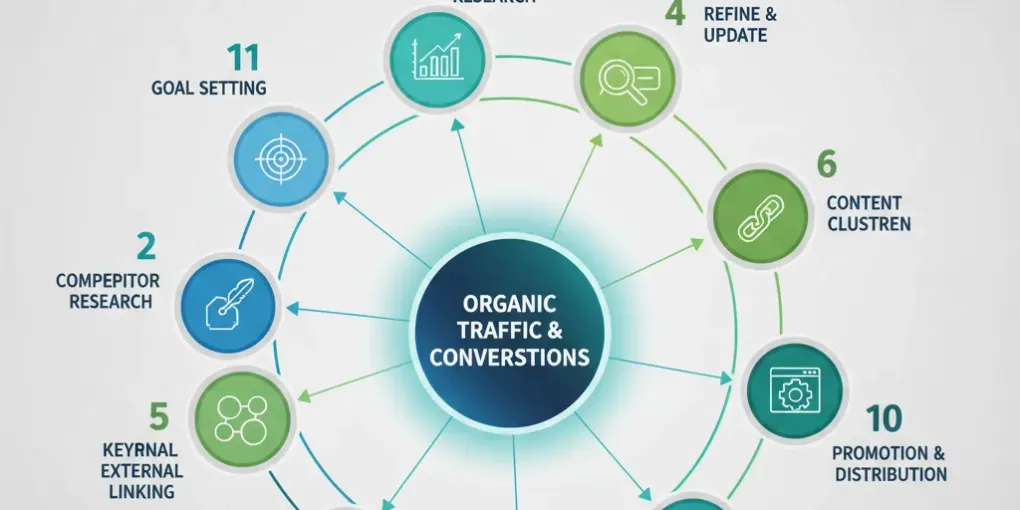
11 Steps: Build Your SEO Content “Battle Map”
Now that we know how to lay the foundation, here come the actual construction steps.
Step 1: Set a goal (Goal Setting) He who fails to plan, plans to fail. What do you want to achieve with SEO? Get a core product keyword into Google’s top 3? Or grow organic traffic 50% within six months? Set the goal — the more specific the better (SMART principles) — and define exactly which KPIs you’ll measure it by, such as keyword rankings, organic traffic, click-through rate, etc.
Step 2: Know your enemy — see what competitors are doing (Competitor Research) Who are your competitors in your core space? Search your core keywords on Google — whoever ranks on top is your competition. Go analyze their sites and see:
- What content have they published?
- Which content gets the most traffic?
- Where do their backlinks come from?
- What’s their site structure like? Take the wheat and leave the chaff — find the opening where you can surpass them.
Step 3: Give your site a full “checkup” (SEO Audit) Before starting large-scale content production, audit your own site, both technically and from a content perspective.
- Technical audit: Check site speed, mobile experience, crawl errors, and other issues.
- Content audit: Analyze existing content — what performs well and what are “zombie pages” (no traffic for a long time)? Should underperformers be updated or deleted? This audit surfaces a lot of low-hanging fruit.
Step 4: Define your core battlefield (Define Your Core Topic) What’s your core business? Where do you most want to build authority? That’s your “core topic.” For example, if you run an independent site selling ergonomic office chairs, then “ergonomic office chair” is one of your core topics.
Step 5: Branch out from the core battlefield into more topics (Expand to Content Clusters) Around your core topic, expand into more related subtopics like a mind map — these are “topic clusters.” For example, around “ergonomic office chair,” you could branch into:
- Benefits of ergonomic chairs
- How to choose an ergonomic chair
- Best ergonomic chairs review
- Ergonomic chairs for back pain These subtopics form your content matrix.
Step 6: Mine keywords — and even more, mine users’ minds (Keyword Research & User Intent) Now do keyword research for each subtopic. But remember: don’t just find words — analyze the “user intent” behind them. When a user searches this term, do they want to buy something (transactional), learn something (informational), or find a specific website (navigational)? Understanding intent tells you how the content should be written.
Step 7: Build your content pyramid (Build Your Topic and Cluster Structure) Now organize your content.
- Top layer (pillar page): one very comprehensive, long-form overview article on the “core topic.”
- Middle layer (cluster pages): articles on each “subtopic.”
- Links (internal links): tie them together with internal links. Every cluster page links back to the core topic page, and the core page links out to the important cluster pages. This creates a clear, mutually supportive content network.
Step 8: Plan your content production line (Plan Content Production) With the map in hand, it’s time to march. I recommend building an editorial calendar — plan what content goes out each week, who writes it, and when it publishes. For B2B independent sites, prioritize content with stronger buying intent, like product comparisons and solution articles — you’ll see results faster.
Step 9: The final touch of on-page SEO (Implement On-Page SEO) When your content is written and published, don’t forget on-page optimization.
- Put the core keyword in the title, URL, and H1 tag.
- Write a compelling meta description to boost click-through.
- Compress images and add alt text.
- Make sure the article is clearly formatted and easy to read.
Step 10: Good wine needs no bush? No — don’t skip off-page promotion (Off-Page SEO) Publishing content isn’t the finish line — it’s the starting line.
- Backlink building: find ways to earn links to your content from other high-quality sites. They’re “votes” for your content’s value.
- Content distribution: share your articles on social media, industry forums, and email lists so more people see them.
Step 11: Track continuously and keep optimizing (Track Your Content Performance) Remember the KPIs you set in Step 1? Now’s the time to track them with tools like Google Analytics and Google Search Console.
- Which articles bring the most traffic?
- Which keywords are climbing in rankings?
- How’s the time-on-page looking? The data tells you what’s working and what needs improving. SEO is a process of continuous optimization — there’s no set-it-and-forget-it.
Final Thoughts
So — after reading through these 11 steps, doesn’t everything feel clearer?
Building an SEO content strategy is like playing a big game of chess. It takes patience and positioning; you can’t win in a single move. But as long as you follow this map and execute and optimize step by step, your site will slowly build a real moat.
Stop obsessing over keyword rankings alone. Play the long game and become the expert in your field. When you genuinely and consistently create value for users, Google has no reason not to love you.
I hope today’s share sparks some ideas for you.
References:
- How to Create an Effective SEO Content Strategy in 11 Steps (inlinks.com)