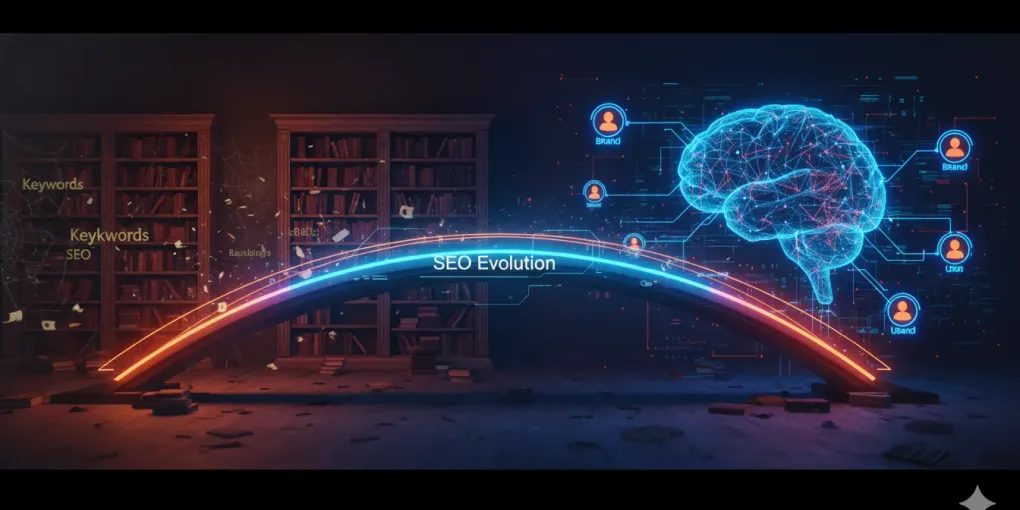
Traffic Down, Orders Up? The Evolution of SEO: From Traffic Catcher to Demand Creator
Hi everyone, this is Neo.
With AI search — ChatGPT, Google AI Overviews — rewriting how traffic gets distributed, many independent-site operators are going through a “data illusion”: organic traffic in GA4 is flat or even falling off a cliff. That’s not a sign SEO has stopped working. It’s a direct reflection of a structural shift in the search ecosystem.
When users can get answers straight from an AI response without clicking a link, the zero-click era has arrived. That forces us to rethink SEO’s core value — moving from Performance SEO, which chases raw traffic volume, to Demand SEO, which fights for user mindshare and brand definition.
Today I’m breaking down this transformation — and how to respond as an independent-site owner or operator.
1. Why Traditional “Traffic Thinking” Stopped Working
For the past decade-plus, SEO’s core logic has been “capturing existing demand.”
User has a problem -> searches a keyword on Google -> sees your site -> clicks through -> looks for the answer. Your job was to get that keyword to page one — like grabbing the most visible spot on a supermarket shelf.
In the AI era, that path is severed.
1. AI Intercepts: The Answer Is the Destination
Users today — especially the younger generation — just ask ChatGPT or Perplexity when they hit a problem. Say someone searches: “best running shoes for flat feet.”
- Before: Google gave 10 links and they clicked through review after review.
- Now: AI answers directly: “Based on your needs, I’d recommend the Brooks Adrenaline GTS and Asics Kayano for their arch support…”
The user has their answer and closes the window. Zero-click just happened. Your site ranks on page one, but the user never walked in.
2. The Funnel Moved Up: From “Comparison” to “Exploration”
We used to intercept users when they were ready to buy — bottom of funnel. Now AI steps in while they’re still exploring the problem — top of funnel. The moment AI tells the user “Brooks is the best,” their mind is made up. Even if they later Google it, they’ll search “Brooks running shoes price” — not “best running shoes.”
Neo’s take:
We used to wait for fish to bite (Performance SEO). Now AI is forcing us to farm the fish (Demand SEO). If you’re not in AI’s recommendation list, you’re out before the user even starts searching for specific products.
2. What Is Demand SEO?
In plain terms, Demand SEO is getting AI to know you, trust you, and recommend you unprompted.
It stops obsessing over individual keyword rankings and focuses on your brand entity’s presence and reputation across the web.
As Search Engine Journal put it:
“AI has changed the discovery model. Instead of a list of links, it delivers a synthesized answer. That reduces clicks, but increases brand touchpoints.”
So your goal isn’t getting users to click through — it’s getting your brand name into AI’s answers. That’s what we call mental availability.
3. In Practice: How to Do Demand SEO
The rules changed, so our playbook has to change too. Here are 3 core strategies I’ve distilled:
1. Build a Clear Brand Entity
AI is like a hyper-achieving student that understands the world by reading the entire web. You need to tell it clearly: who are you? What do you do? Who do you serve?
- Wrong: stuffing your site with “cheap shoes,” “best shoes,” “discount shoes.”
- Right: on your About Us page, Schema structured data, and every bio across the web, say one consistent thing: “Brand X is a premium running shoe brand specializing in flat-foot correction for marathon runners.”
When AI can summarize you accurately in one sentence, it’ll dare to recommend you.
2. Optimize Your Digital Footprint (Digital PR & Authority)
AI weighs authority and consensus heavily. If ChatGPT sees positive things about you on TechCrunch, Forbes, or authoritative industry forums (like Reddit’s niche subreddits), it’ll consider you a “trustworthy entity.”
- Action items: don’t just publish on your own blog. Win industry media coverage, genuinely answer questions on Quora and Reddit, and earn high-quality Trustpilot reviews.
- Why: that third-party content is AI’s “evidence” for verifying your brand’s credibility.
3. Content Strategy: From “Keywords” to “Perspective”
AI has already read every generic piece of content on the web. If you’re just spinning a “what are running shoes” article, AI won’t deign to cite you. You need to deliver information gain.
- Original data: publish a “2026 Runner Foot Health Report.”
- Unique perspectives: counter-intuitive industry insights.
- Deep expert content: E-E-A-T (experience, expertise, authoritativeness, trust) matters more than ever.
Neo’s take:
Think of your site as a reference work cited by an encyclopedia — not a sales brochure. Only high-quality references get cited by AI.
4. How Do You Measure Results?
Traffic may fall, so what do we watch instead? Stop doom-scrolling the Sessions count in GA4. Track these instead:
- Branded search volume: are more people searching your brand name directly? That means AI or other channels have already done the “seeding.”
- Direct traffic: users typing your URL straight in means brand mindshare is forming.
- Share of model: this one’s new. Ask ChatGPT questions relevant to your industry and see how often you come up. Try: “List top 5 brands for [your industry].” Are you in the list?
5. Summary
SEO is returning to marketing’s true essence: brand.
For a decade, we obsessed over algorithm loopholes, trying to game search engines with technical tricks. Now AI has slammed that door shut. It’s forcing us to do what actually matters: build a brand, create great content, and earn user trust.
The transition from Performance SEO to Demand SEO hurts — but it’s the long-term player’s win.
One last thought from Neo:
In the AI era, the best SEO is making your brand the one without which AI’s answer simply isn’t complete.