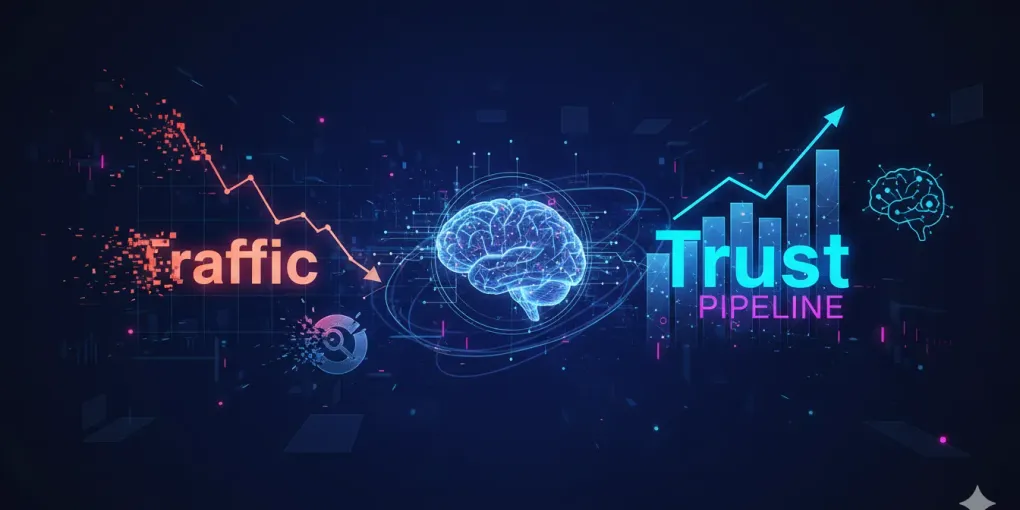
Traffic Halved, Revenue Doubled? Inside SEO's 'Great Decoupling' of 2026
Hi everyone, this is Neo.
Lately I’ve been hearing a lot of founders and operators in the e-commerce world complain: “Neo, my traffic is dropping hard. Is SEO dead?”
When I hear that, I usually fire back: “OK, but did your inquiries or demo bookings drop?”
More often than not, the answer surprises them: “Huh… actually no, they barely moved — maybe even grew a bit.”
Exactly. That’s the phenomenon I want to talk about today — a big one that Kevin Indig calls “The Great Decoupling.”
In plain terms: SEO traffic and business growth (pipeline) are no longer joined at the hip. Traffic may be falling, but if your brand is strong enough, revenue can still be climbing.
Today, Neo is going to break this down in depth, and talk about how we should adjust our playbook in the age of AI search.
1. Traditional Search Volume: Peaked and Fragmenting
First, let’s face reality: traditional search volume may have already peaked.
According to Kevin Indig’s analysis, over the past year, total search volume for roughly 10,000 short-head keywords (the big generic terms with massive volume) grew just 1.2% — and it’s expected to decline from here.

There are two main reasons behind this:
-
Fragmentation into long-tail: Users’ search habits have changed. Instead of typing one big generic word, they search for very specific, niche long-tail phrases. The demand hasn’t disappeared — it’s just been scattered.
-
Bypass behavior: You’ve all felt this one. When you have a question now, how many people just ask ChatGPT, Claude, or Gemini directly? Or read the answer straight from Google’s AI Overviews without ever clicking through to a website.
Neo’s take: Stop obsessing over rankings and traffic for those few big head keywords. If your SEO strategy is still laser-focused on “traffic growth,” you’re like someone still optimizing fax machines in 2010 — pointed in the wrong direction. The battlefield has moved to AI interfaces and hyper-specific long-tail demand.
2. Why Can Revenue Rise While Traffic Falls?
Sounds counterintuitive, right?
Traditional SEO logic is linear: Higher ranking -> More clicks -> More traffic -> More inquiries
But in the AI era, that chain is broken, because AI ate the click.

Even if a user never clicks through to your site, they may have already seen your brand in the AI’s answer, learned about your products, and even built trust.
- The education happens inside the AI interface: Users ask around in ChatGPT and already know who the industry leader is and whose product is good.
- The brand choice happens afterward: When they decide to buy, they go straight for your brand.
That’s how you get the bizarre “traffic halved, revenue doubled” pattern. Traffic is just a process metric; trust and purchase intent are the outcomes. AI took the clicks, but it left the trust in the hands of brands with real substance.
Neo’s take: SEO is no longer just a “traffic channel” — it’s becoming a “brand-building channel.” Your content isn’t just for search engine crawlers anymore; it’s also “food” for large language models. If an LLM recognizes your authority, it will recommend you when answering user questions — even if the user never clicks the link.
3. In the AI Era, What Is “Brand Strength”?
Since traffic is unreliable now, how do we win? The answer is brand strength.
But it has a new definition in this new era. Kevin Indig summed it up in four key elements, and I think he nailed it:
-
Topical Authority: Are you the “encyclopedia” of your niche? It’s not about how many keywords you cover — it’s whether you fully own the concept map of the field.
-
ICP Alignment: Does your content specifically answer the questions your ideal customers care about most (say, B2B procurement managers)? Relevance beats volume, every time.
-
Third-Party Validation: This matters more than the traditional DA (domain authority). Are you cited by authoritative industry media, or by random corner-of-the-internet sites? AI cares a lot about “who’s vouching for you.”
-
Positioning Clarity: An LLM must be able to clearly figure out “what you do.” If your positioning is fuzzy, AI won’t mention you in relevant answers. The clearer your positioning, the higher the chance you get cited.
Neo’s take: SEO used to be about stacking pages and keywords. Now it’s more like PR and branding. You need to make AI think: “In this niche, this company IS the authority — it wouldn’t be objective to leave them out.”
4. And Most Importantly: Don’t Panic — Switch Your Metrics
A lot of operators will ask: “Neo, so how do I report to my boss? Traffic is down and he’s going to yell at me.”
You need to have a real conversation with your boss: “Traffic and revenue have decoupled. This is an industry-wide trend (feel free to forward him this article). We need to track new metrics.”
Here’s what I recommend watching:
- Brand Lift: Are more people searching your brand name directly?
- Pipeline Influence: How many customers mention “I saw your content online” during sales calls?
- LLM Visibility: This is a new one — test whether ChatGPT or Gemini mentions your brand when you ask industry questions.

To sum up:
- Traffic no longer equals revenue — don’t panic over surface-level metric drops.
- AI ate the click, but it preserved trust.
- Shift from “keyword-first” to “ICP-first” — go deep, not wide.
- Build brand authority so AI actually wants to recommend you.
SEO isn’t dead. It just evolved — from a simple “traffic acquisition tool” into a more sophisticated “mind-share conquest tool.”
In this era of the Great Decoupling, whoever sees this first wins the head start in the next wave of competition.
References:
I hope this article gave you some insight. I’m Neo — see you next time.