7 Big Predictions for SEO and Marketing in 2026
Hi everyone, this is Neo.
At this time every year, the marketing world looks to the future. Recently, renowned growth expert Kevin Indig published his “SEO, Marketing, and Tech Predictions for 2026.”
These predictions aren’t just about technology — they’re about the livelihoods of everyone running independent sites and cross-border e-commerce. In 2025, we watched AI go from “toy” to “tool,” and Kevin believes 2026 will mark the beginning of the “Agentic Era” — AI will no longer just read the internet; it will start writing it.
As an independent site operator working on the front lines, I read the report carefully and combined it with the realities of Chinese sellers to bring you this deep dive.
Prediction 1: AI Visibility Tools Face a Reckoning
Core thesis: The market is flooded with single-purpose “AI visibility tracking tools” (for monitoring how many times your brand appears in ChatGPT answers and the like). Kevin predicts that by Q3 2026, these standalone tools will face an “extinction event.”
Why:
- Features aren’t products: Giants like Semrush have already folded “AI tracking” in as a small feature. Standalone tools will struggle to survive.
- Dubious ROI: It’s still hard to prove that optimizing for AI answers (GEO/AEO) delivers a concrete return on investment.
Neo’s Take
For us cross-border sellers: don’t blindly buy those expensive standalone tools that only tell you “what rank you are in ChatGPT.” Real value lies in “action,” not mere “monitoring.” The future belongs to agents that automatically optimize your content and fix problems — not dashboards that just report numbers.
Prediction 2: ChatGPT Launches Its First “Quality Update”
Core thesis: In 2026, cheating your way to AI rankings — stuffing garbage backlinks and mass-generating AI content — will get harder and harder. AI agents will start using multi-source corroboration to filter out junk information.
Why: Current RAG (retrieval-augmented generation) technology is still fairly easy to mislead with hallucinations or deceive with single-source junk content. But future AI will have a “referee” mechanism: one AI retrieves, another AI verifies — only information corroborated by multiple sources gets adopted.
Neo’s Take
The old saying “content is king” still holds in the AI era — maybe even more so. As a B2B or B2C brand, we must build real brand authority. Don’t try to deceive AI with black-hat tactics. Building high-quality content that authoritative sites cite is the only path to being “trusted” by AI.
Prediction 3: Continued Click-Drops Lead to a “Dark Web” Defense
Core thesis: As Google AI Overviews take over more search results, traditional websites’ CTR is plummeting. To survive, high-quality content publishers will build a “dark web” — not illegal sites, but locking premium content behind paywalls or login walls to stop AI from crawling it.
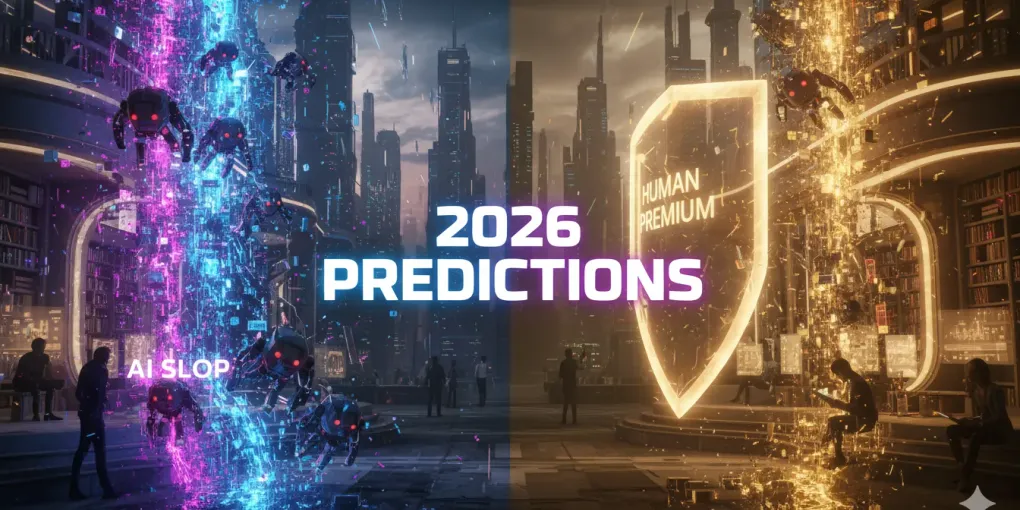
Why: If you don’t block AI, it will “freeload” your content and answer users directly, leaving you with zero traffic. In the future, the internet will split into two layers:
- The AI junk layer: free, AI-generated, homogenized information.
- The human premium layer: deep insights written by real people, gated behind payment or identity verification.
Neo’s Take
This is a dangerous signal — and an opportunity. If your independent site blog only writes generic explainers, AI will fully replace you. You need to deliver “experiential content” — real product reviews, unique industry opinions, proprietary data reports. Meanwhile, building your own owned traffic (email lists, membership communities) becomes a matter of life and death, because public traffic may get cut off by AI.
Prediction 4: AI Forces UGC Platforms to Separate Feeds
Core thesis: “Identity fraud” will become the biggest risk. Platforms like YouTube and LinkedIn may split their content feeds into two streams: “verified humans” and “synthetic/unverified.”
Why: Deepfake technology is too powerful. AI influencers are safe and obedient, and brands might even prefer them. To tell real from fake, platforms will require real humans to verify with biometrics, and use C2PA (Content Provenance and Authenticity) digital signatures.
Neo’s Take
Trust will be the most expensive currency of 2026. For brands going global, “showing real human faces” will surge in value. If your founder genuinely stands up publicly, or your videos carry clear human-verification marks, user trust skyrockets. Conversely, fully AI-generated marketing assets may get labeled “unverified” and meet instinctive user rejection.
Prediction 5: ChatGPT’s Ad Platform Provides “Demand Data”
Core thesis: To make money, OpenAI may fully embrace advertising in 2026 — potentially becoming a marketplace similar to the App Store.
Why: The compute costs of running AI are enormous; subscriptions alone can’t cover them. Leaked OpenAI code already contains references to “search ad carousels.” That means brands could not only run ads but also get a data backend similar to Google Search Console, seeing exactly what questions users ask that relate to your products.
Neo’s Take
This is a new traffic dividend for cross-border e-commerce! Once ChatGPT opens its ad system, the traffic precision will be extremely high (users express explicit needs in conversation). We need to watch this closely and get our first “ticket” ready.
Prediction 6: Perplexity Gets Acquired
Core thesis: Perplexity, the well-regarded AI search product, may sell in 2026 for $25-30 billion. Buyers could be Musk’s xAI or Salesforce.
Why: Despite being a great product, Perplexity’s user growth has hit a ceiling (roughly 30 million monthly actives vs. ChatGPT’s 800 million). And without a high-margin ad network, every search burns cash, making independent survival hard to sustain.
Neo’s Take
Tool consolidation is inevitable. For us users, this means preparing for multi-platform distribution. Don’t put all your SEO eggs in Google’s basket, and don’t fixate on Perplexity alone — it may get absorbed into a larger ecosystem (like social media platform X or enterprise software Salesforce).
Prediction 7: Competition Tanks Nvidia’s Stock by -20%
Core thesis: Competition in the AI infrastructure space intensifies. Tech giants (Microsoft, Google, Amazon) are designing their own chips to reduce dependence on Nvidia, driving Nvidia’s stock down.
Why: For the giants, Nvidia’s chips are too expensive — a “tax on profits.” They only need “good enough” chips to run models, not the top-of-the-line ones.
Neo’s Take
This one seems unrelated to us, but it has deep implications. Falling chip costs mean falling AI inference costs. In the future, AI features inside SaaS tools may get cheaper — or even free. That’s a win for small and mid-sized sellers.
Summary: 2026 — Survival of the Fittest
Reading these 7 predictions, I feel both excited and alert.
The digital marketing world of 2026 will no longer be a war of “keywords” — it will be a war of “trust” and “authenticity.”
As Chinese businesses going global, what should we do?
- Return to authenticity: Increase the share of real human content, real case studies, and real reviews.
- Build moats: Cultivate owned traffic; don’t fully depend on search engines’ charity.
- Embrace change: Keep a close eye on advertising opportunities on new platforms like ChatGPT, and be bold in trying new traffic sources.
As evolutionary biology puts it: “It is not the strongest of the species that survives, nor the most intelligent, but the one most responsive to change.”
Hope this article gives you some food for thought. If you have more questions about SEO in the AI era, feel free to discuss in the comments!
References: Kevin Indig - 7 SEO, Marketing, And Tech Predictions For 2026