[Deep Dive] Why Your SEO Team Is Always Playing Firefighter: The Real Reason Enterprise SEO Fails
Hi everyone, this is Neo.
In my consulting work with independent store operators, I constantly hear owners complain: “Why is our SEO so slow to show results?” “Why do these same low-level mistakes keep happening — didn’t we fix them last month?” “Why does the dev team always deprioritize SEO requests?”
Most of the time, people instinctively blame the SEO team — thinking it’s not capable enough, or execution is the problem.
But today I want to share a brutal truth: most enterprise SEO failures aren’t because the tactics are bad — the “org structure” itself is doomed from the start.
Many companies’ SEO teams have been placed in a position destined to “take the blame” since day one.
Today let’s go deep on why your SEO operating model might be “structurally broken” — and how catastrophic that failure becomes in the age of AI search.
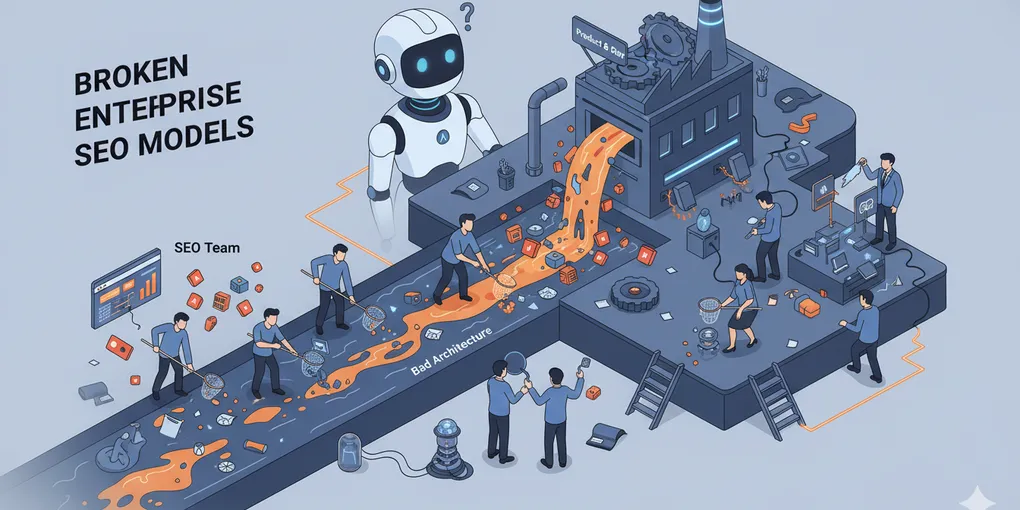
The Core Problem: SEO Sits Downstream, Doing Janitor Work
In most companies, how does SEO actually operate?
Usually like this:
- The product manager sketches out the wireframes.
- The design team produces high-fidelity UI.
- The dev team writes the code and gets ready to ship.
- Last of all, someone calls in the SEO team: “Hey, we’re about to launch — can you check for any SEO issues, and throw together a few TDKs (title, description, keywords)?”
That’s the classic “downstream model.”
In this model, SEO is treated as QA. By the time SEO gets involved, the core architecture, URL structure, page logic, and tech choices are all locked in.
So what happens when problems surface? SEO can only file bug tickets. The dev team says: “That architecture can’t be changed now — let’s look at it next release.” Or: “That change is too costly — ship it first, optimize later.”
So the SEO team becomes a “cleanup crew.” They trail behind product and dev, cleaning up the “trash” that should never have been created in the first place.
Neo’s take:
Treating SEO as a “QA checkpoint” before launch is the biggest misconception in enterprise SEO. Real quality control should happen at the source. Think about river pollution: are you going to keep fishing trash out of the water downstream, or shut off the upstream discharge pipe? The current model is: upstream keeps polluting (creating SEO defects) while downstream keeps fishing trash (fixing bugs). As long as the source never changes, the trash never runs out.
Four “Structurally Broken” Models
Based on this core problem, we regularly see four typical, doomed-from-the-start SEO operating models inside companies. See which one your company matches.
1. The Audit Factory
Characteristics: The team is great at finding problems — every week they produce a thick “SEO diagnostic report.” Outcome: The report goes out and sinks like a stone. Why: SEO has “advisory power” but no “decision power.” In this model, the SEO team becomes a “bug-reporting machine.” Dev treats SEO as backlog generators. As long as the root process problem is never fixed, SEO gets stuck in the death loop: “find problem → nobody fixes it → problem recurs → find problem again.” The fallacy: Treating “producing reports” as “producing results.”
2. The Ticket Desk
Characteristics: SEO operates like an internal customer service department, or an IT help desk. Outcome: SEO requests are always stuck in the queue. Why: In Jira or whatever project management software, SEO priorities always rank below “new feature development” or “the boss’s latest whim.” SEO requests usually get tagged P3 or P4 priority. By the time the fix is finally scheduled, the site may have been redesigned, and new problems have appeared. The fallacy: Trying to drive growth by “patching bugs.”
3. The Local Islands
Characteristics: Most common in multinational B2B/B2C companies. Outcome: HQ has its own standards; local offices have their own ideas. Why: Say you run a global DTC store. HQ defines SEO guidelines, but the Germany office decides it “doesn’t fit the local market” and rewrites the page structure; the Japan office hired a local agency that set up a completely different set of URL rules. Consequence: The signals your whole site sends to Google are chaotic and contradictory. The fallacy: Lacking unified, “centralized” SEO governance.
4. The Orphaned Center of Excellence
Characteristics: The company creates a fancy “SEO Center of Excellence (CoE)” responsible for standards, training, and enablement. Outcome: It becomes a “forgotten library.” Why: The center writes plenty of beautiful documentation and SOPs — but has no enforcement power. The product team skips the SOPs to hit deadlines; the dev team skips structured data to save effort. Consequence: Best practices exist only on paper and never land in reality.
Why Is This More Fatal in the AI Era?
Five years ago, these four models were inefficient but survivable. Google’s algorithm was relatively simple back then — as long as you fixed the pages afterward, rankings would come back.
But in the AI search (SGE/AIO) era, this model is fatal.
Why? Because AI isn’t “indexing” your pages — it’s “understanding” your entities.
AI search (like Google’s AI Overviews and ChatGPT Search) depends heavily on:
- Clear information architecture
- Explicit entity definitions
- Machine-readable data structures
- Consistent signals
These things must be “natively” built into your site architecture — not “patched” on afterward.
If your site architecture was messy from the design stage, AI can never build “trust” or “understanding” of you. Once AI concludes your data structure is a mess and your entity relationships are unclear, it will simply ignore you.
Note: AI won’t give you multiple chances to correct yourself like traditional crawlers do. In the AI world, structure is qualification.
Neo’s take:
AI SEO is “genetics.” If the genes are bad, plastic surgery later won’t help much. When SEO sits downstream, it loses the chance to improve the “genes.”
Summary: Move SEO Back Upstream
So if your SEO program never seems to improve, stop blaming the SEO specialist for not trying hard enough, or the agency for being unprofessional.
Take a hard look at your org structure:
- Does the SEO team get involved at the product design stage, or just before launch?
- Are SEO requirements built as core features, or handled as bug fixes?
- Does the SEO lead have the authority to veto architectures that aren’t search-friendly?
True enterprise SEO shouldn’t be a “service department” — it should be an “infrastructure department.”
It should be like the foundation, laid before the building goes up.
Only when SEO transforms from the “downstream janitor” into the “upstream architect” will your store’s traffic truly explode in the AI era.
References for this post: