2026 SEO Trends Revealed
Hi everyone, this is Neo.
Before we know it, 2025 is wrapping up. If 2024 and 2025 were the years we got “pinned to the ground” by AI and anxiously learned our way around it, then 2026, I believe, will be the watershed of “application and reinvention.”
Recently I read Search Engine Journal’s (SEJ) annual predictions article featuring interviews with 20 top SEO experts, and it really hit home. We used to do SEO staring at Google rankings and keyword density. But by 2026, if you’re still only staring at Google’s “blue links,” you might not even have a seat at the table anymore.
Today, combining these experts’ views with my own hands-on experience, I want to talk about the new rules of SEO in 2026. This isn’t just about traffic — it’s about the survival of our independent sites.
1. The New Definition of SEO: Search Everywhere Optimization
When we used to say SEO, we meant Google SEO by default. But users have changed.
Your customers might search for product tutorials on TikTok, watch reviews on YouTube, ask for real opinions on Reddit, or even ask ChatGPT directly: “Recommend a CRM system suitable for small and medium businesses.”
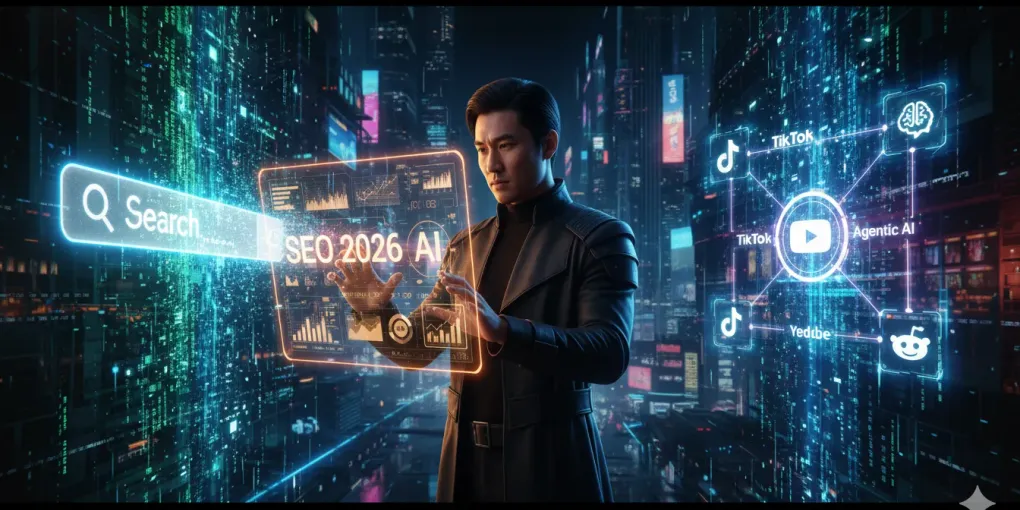
Trend breakdown: The experts propose a new concept: Search Everywhere Optimization. Search is no longer confined to search engines. TikTok, YouTube, ChatGPT, Claude, Reddit… these are all search engines. Wherever your audience is, that’s your battlefield.
Neo’s practical take:
For us independent site folks — especially B2B sellers — don’t dismiss TikTok as a toy for kids. A friend of mine in the machinery business started posting “How-to” videos on YouTube and TikTok last year, and now the quality of his inquiries is higher than what he gets from Google Ads.
My advice: Don’t put all your eggs in Google’s basket. Go research where else your customers look for answers besides Google. If you’re B2C, Instagram and TikTok are must-haves; if you’re B2B, LinkedIn, industry forums, and Reddit absolutely cannot be ignored.
2. Welcome the “Agentic AI” Era: Make Machines Able to “Read” You
This is a relatively new concept — write this one down: Agentic AI.
Future AI won’t just answer questions — it’ll do things for you. For example, a user will tell AI: “Book me a flight to New York — cheapest option, and I need a vegetarian meal.” The AI will search, compare, and even place the order on its own.
Trend breakdown: If your site’s data structure is a mess and AI can’t read your prices, inventory, or product specs, it can’t recommend you to users. Future SEO is optimizing for systems that read like machines. What we need is to be “retrieved,” not merely “ranked.”
Neo’s practical take:
This sounds very technical, but it’s actually quite concrete. For example — does your independent site have Schema (structured data)? Are your product specs (dimensions, materials, weight) written inside images, or in crawlable text?
My advice: Audit your site’s technical SEO right now. Make sure your product information is structured and easily crawlable by AI. For B2C sellers, the accuracy of your Merchant Center feed is critical; for B2B, make sure your service capabilities and spec tables are clean HTML text — not screenshots.
3. Brand Authority: The Passport to the AI Era
In an era drowning in AI, what’s scarcest? Trust.
When LLMs generate answers, they tend to cite “trustworthy” sources. If your brand has zero presence on the internet, AI won’t dare cite you.
Trend breakdown: E-E-A-T (Experience, Expertise, Authoritativeness, Trust) is still core. But now, mentions may matter more than backlinks. AI judges your brand sentiment through mentions across the web.
Neo’s practical take:
We used to spam backlinks regardless of quality. Those days are over. What you need now is “effective exposure.”
My advice:
- Do more digital PR: Pitch to authoritative industry media, or accept interviews.
- Value reviews: Ratings on Trustpilot, reviews on Google Maps — these are evidence AI uses to judge your reliability.
- Be a real human: Stop using stock photos on your “About Us” page. Put up real team photos and the founder’s story. Let AI and users know there are living, breathing people behind the screen.
4. Content Strategy: Human > AI
This one might sound counterintuitive. The stronger AI gets, the more valuable “the human touch” becomes.
The internet is now flooded with AI-generated slop. Users are tired of the same recycled nonsense, and Google has started cracking down on it.
Trend breakdown: In 2026, the articles that win will be the ones with unique opinions, real experiences, and original data. AI can help us draft and polish, but the core “soul” must come from a human.
Neo’s practical take:
I tested several articles recently. Pure AI-written ones got indexed fast — but their rankings dropped just as fast. Meanwhile, my own battle-tested recap articles, written with strong personal opinions — even a bit “extreme” — have very stable long-tail traffic.
My advice: Say you sell outdoor tents. Don’t just write “5 benefits of a tent.” Write a real story like “I camped through a storm for 3 days and this tent saved my life.” Add your video and real photos — that’s the moat AI can’t replace.
5. Focus on “Money,” Not “Traffic”
Last but not least — the most down-to-earth point.
The experts all emphasize: Revenue over Traffic.
With AI Overviews taking over the top of search results, CTR decline is inevitable. We used to chase 100k monthly active users with abysmal conversion rates.
Neo’s practical take:
The traffic dividend era is over. What we need now is “precision strikes.”
My advice: Even if your site only gets 100 unique visitors a day — if those 100 are precise B2B buyers, that’s worth far more than 10,000 random visitors a day.
Focus on conversion rate optimization (CRO) and user retention. Squeeze every drop out of each visitor: get them to sign up for your email list and build your owned audience. Because only in your own database do users truly belong to you.
Summary
SEO in 2026 is no longer a simple “keyword-filling game.”
It’s a comprehensive battle of Brand, Tech, and Authenticity.
- Widen your horizons: Anywhere there’s a search box is an SEO battlefield.
- Embrace technology: Make your site AI-friendly (structured data).
- Return to the essentials: Create authentic content and build a trustworthy brand.
In this era of rapid technological change, the one constant is delivering value to users.
I’m Neo. If you have any anxieties or thoughts about running independent sites in 2026, feel free to chat with me in the comments.
References: Search Engine Journal - “20 SEO Experts Offer Their Advice For 2026”